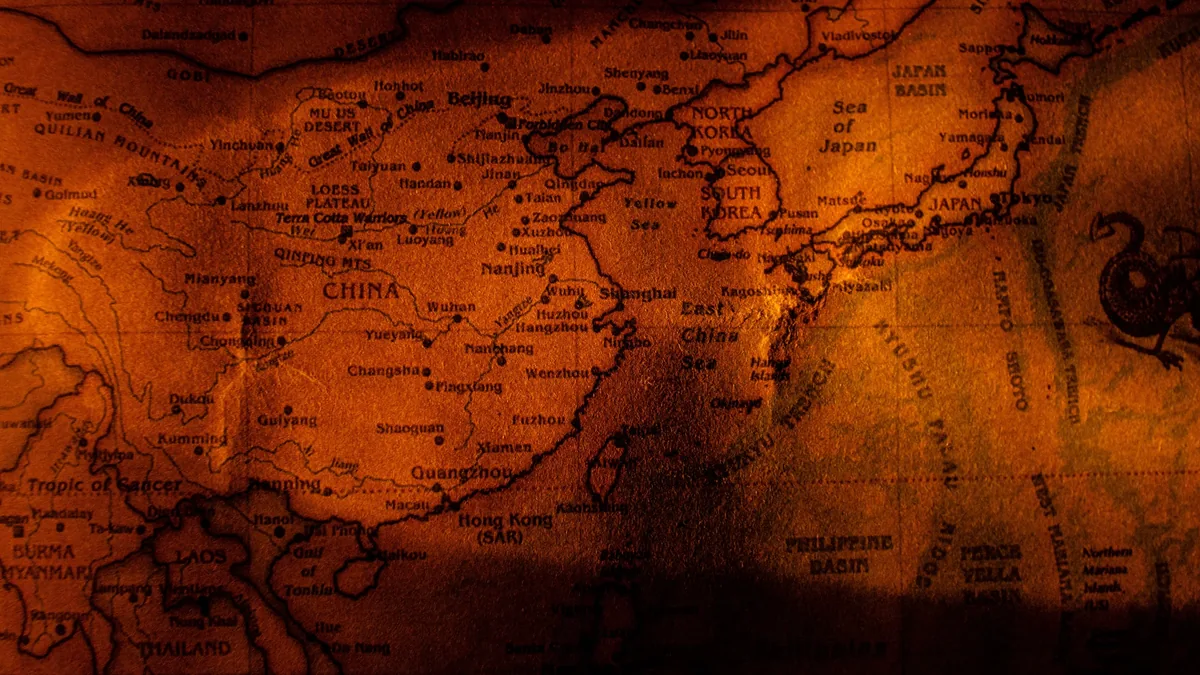
East Asia
| Name in local languages | Varied (e.g., 东亚, 東アジア, 동아시아) |
|---|---|
| Core constituent entities | People's Republic of China, Japan, Mongolia, North Korea, South Korea, Taiwan |
| Geopolitical concept | A cultural and historical region, not a formal political union |
| Primary cultural sphere | Historically within the Chinese cultural sphere |
| Dominant language families | Sino-Tibetan, Japonic, Koreanic, Mongolic |
| Traditional script systems | Logographic (Chinese characters) and phonetic scripts |
| Major modern economies | Include some of the world's largest and most technologically advanced |
Origin and history
Asia Oriental is a term originating in European geographical and cultural discourse, first gaining consistent usage in the 18th and 19th centuries. It does not stem from a single country within the region itself but was an external categorization imposed by Western explorers, cartographers, and colonial administrators. The term was used to describe the lands east of the Indian subcontinent, primarily encompassing China, Japan, Korea, and later, parts of Southeast Asia. Its creation was part of a broader Eurocentric worldview that divided the Asian continent into "Near," "Middle," and "Far" East based on proximity to Europe. The concept has been largely superseded in modern academic and diplomatic language by more precise terms like "East Asia" and "Southeast Asia," which carry less historical baggage. The historical usage of "Asia Oriental" often conflated diverse civilizations under a single exoticized label, influencing Latin American perceptions through filtered European narratives.
What it is for
The term "Asia Oriental" historically served to categorize and conceptually manage a vast and unfamiliar part of the world for European audiences. Its primary function was as a geographical and civilizational label, grouping distinct cultures, empires, and peoples under a single umbrella for the sake of simplified study, trade, and colonial policy. In academic contexts, it was used to define a field of study, often called "Orientalism," which examined the languages, histories, and cultures of these regions from a Western perspective. For traders and diplomats in the 19th and early 20th centuries, it delineated a sphere of commercial and political interest distinct from the "Occident." In contemporary usage, the term is largely archaic and is recognized more for its historical and critical value in discussing colonial legacies than as a practical descriptor. Its modern utility lies in understanding how historical framing shapes current cross-cultural perceptions between Latin America and Asian nations.
Overview
Asia Oriental, in its traditional scope, refers to the cultural and geographical sphere of East Asia, including China, Japan, the Korean Peninsula, and Mongolia, and sometimes extending into mainland Southeast Asia. This region is home to some of the world's oldest continuous civilizations, with profound philosophical traditions like Confucianism, Daoism, and Buddhism shaping its societal structures. It is characterized by significant linguistic diversity, with language families including Sino-Tibetan, Japonic, and Koreanic, though historically shared the use of Classical Chinese as a written scholarly lingua franca. The region has experienced immense historical transformations, from imperial dynasties and shogunates to rapid modernization and economic miracles in the 20th century. Its contemporary global influence is immense, spanning technology, manufacturing, pop culture, and geopolitical power. For a Latin American reader, understanding this region requires moving beyond the monolithic "Oriental" label to appreciate its intense internal diversity and complex historical relationships.
What to know
It is crucial to know that "Asia Oriental" is an outdated term and using "East Asia" or specifying individual countries is more accurate and respectful in modern discourse. The region is not culturally or politically homogeneous; deep historical tensions and distinct national identities exist between its constituent nations, despite some shared cultural heritage. The economic models of Japan, South Korea, and China, while often grouped, have followed dramatically different paths and have varying relationships with global markets and Latin America. The influence of Chinese characters, while historically widespread, does not mean the spoken languages are mutually intelligible; Japanese, Korean, and Vietnamese use them very differently. Religious and philosophical thought in the region is often syncretic, with individuals blending elements of Buddhism, Shinto, folk traditions, and secular philosophies in daily life. For Latin Americans engaging with the region, recognizing the legacy of Western imperialism there provides essential context for contemporary diplomatic and economic relations.
Common questions
Is "Asia Oriental" the same as the "Far East"? Yes, both are largely synonymous, outdated Eurocentric terms that describe a similar geographical concept from a Western viewpoint. Do people in these countries refer to themselves as "Oriental"? No, this is an external label; individuals identify by their nationality (e.g., Japanese, Korean) or as East Asian in a modern geographical context. Is the entire region influenced primarily by Chinese culture? While Chinese civilization exerted a profound historical influence on neighboring states like Japan and Korea, each adapted and transformed these influences into uniquely distinct cultural and political systems. Why is the term considered problematic? It is criticized for perpetuating a power dynamic where the West defines the "Orient" as exotic, backward, and static, a critique central to Edward Said's work on Orientalism. How should I refer to the region today? Use "East Asia" for China, Japan, Korea, Mongolia, and Taiwan, and "Southeast Asia" for nations like Vietnam, Thailand, and Indonesia. How does Latin America's historical relationship with this region differ from Europe's? Latin American engagement was often less directly colonial but has been shaped by later waves of immigration, trade, and a shared experience of existing within a global system historically centered on the North Atlantic.
Pros and cons
A significant pro of understanding the historical concept of Asia Oriental is that it provides a lens to critically analyze how Latin American views of Asia were historically filtered through European colonial knowledge and cultural prejudices. Engaging with this history can foster a more direct and nuanced relationship with individual East Asian nations, free from inherited stereotypes. However, a major con is that continuing to use the term or thinking in its monolithic framework leads to severe cultural misunderstandings, as it erases the fierce national identities and historical conflicts between countries like Japan, Korea, and China. A common mistake is assuming a shared "Asian" mindset or business culture, which can result in failed negotiations or diplomatic faux pas when distinct communication styles and social norms are ignored. Those who regret using this outdated framework are often professionals or academics who find their initial assumptions about regional homogeneity collapse when confronted with complex on-the-ground realities. The framework also tends to marginalize the distinct experiences of Southeast Asia, incorrectly folding them into a narrative centered on China and Japan.
Who it suits
The historical concept of Asia Oriental primarily suits scholars analyzing 19th and early 20th-century European or Latin American texts, where the term appears as a historical artifact that requires contextual understanding. It is relevant for historians of ideas studying the global circulation of colonial-era geographical concepts and their impact on Latin American intellectual history. The term may also have residual, though declining, suitability for older generations in some Latin American countries where the term "Oriente" was traditionally taught in schools and remains in some place names or casual speech. It does not suit modern business professionals, diplomats, journalists, or students seeking accurate and contemporary engagement with East Asian societies, for whom country-specific knowledge is essential. It is also ill-suited for anyone aiming to build equitable cultural exchanges, as its use can signal an unawareness of post-colonial critiques and the agency of East Asian nations in defining their own identities. Ultimately, its utility is confined to meta-discussion about the history of cross-cultural perception rather than as a tool for current understanding.