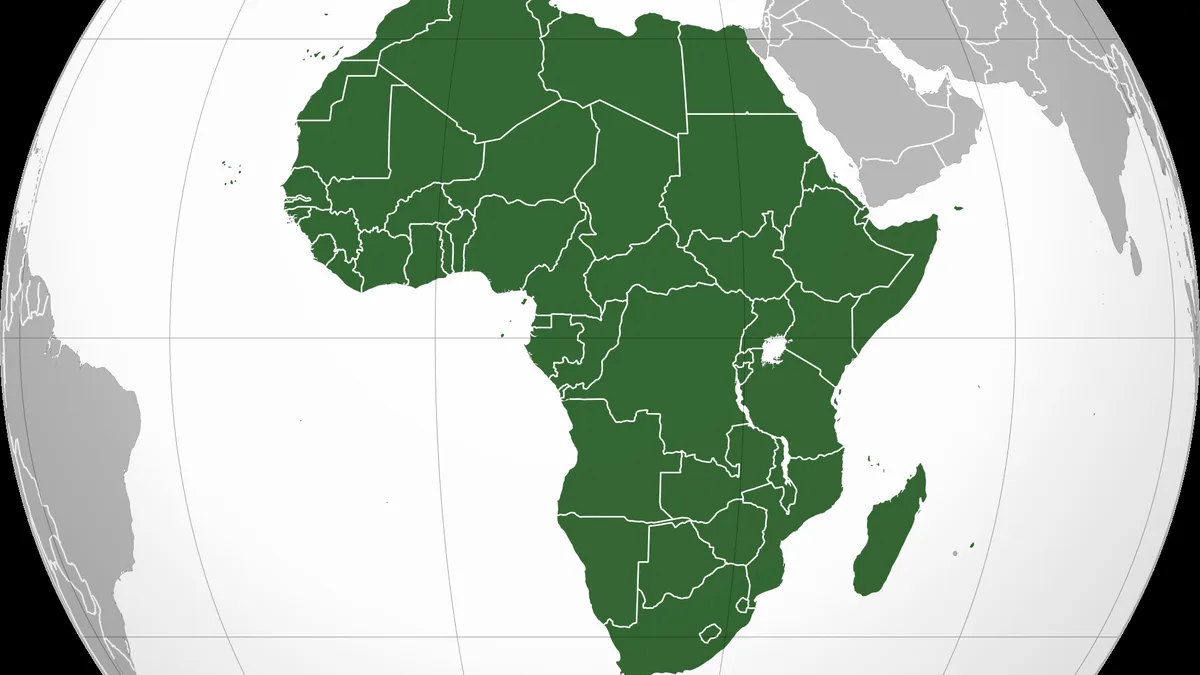
Africa
| Region | Africa |
|---|---|
| Original use | Continent of human origin |
| First documented | Prehistory |
| Geographic size | Approximately 30.4 million square kilometers |
| Major biomes | Desert, savanna, rainforest, Mediterranean |
| Notable geographic feature | Contains the world's longest river (Nile) and largest hot desert (Sahara) |
| Primary language families | Niger-Congo, Afroasiatic, Nilo-Saharan |
| UN-recognized sovereign states | 54 |
Origin and history
The continent of Africa is the cradle of humanity, with the earliest fossil evidence of Homo sapiens dating back hundreds of thousands of years. Modern geopolitical Africa, as understood today, was shaped profoundly by the colonial period, primarily from the late 19th century until the mid-20th century. The current political map, comprising 54 recognized sovereign states, largely solidified in the second half of the 20th century during the wave of decolonization. This process of independence movements created new national narratives while borders often reflected colonial administrative lines rather than pre-existing cultural or ethnic boundaries. The continent's history is not monolithic, encompassing ancient empires like Mali and Aksum, the Swahili Coast trade networks, and diverse kingdoms and stateless societies across millennia. The transatlantic slave trade, originating in the 16th century, represents a catastrophic period that forcibly removed millions and deeply impacted social structures.
What it is for
Africa, as a region, functions as a collective of sovereign nations managing their internal governance and international relations. It serves as a primary source of vast mineral and agricultural resources for the global economy, including critical minerals like cobalt and platinum. The continent provides unique ecosystems and biodiversity hotspots that are crucial for global environmental stability and scientific study. Culturally, it is a wellspring of artistic, musical, and philosophical influence that has shaped diasporic cultures worldwide, particularly in Latin America. Institutionally, the African Union, established in the early 21st century, exists to promote political and economic integration, peace, and security among its member states. The region also functions as a significant arena for global geopolitical and economic interests, from investment in infrastructure to international security cooperation.
Overview
Africa is the world's second-largest and second-most populous continent, characterized by immense geographical, cultural, and linguistic diversity. It contains over 1,500 languages spoken among thousands of distinct ethnic groups, making generalizations about "African culture" inherently inaccurate. The continent features stark economic contrasts, hosting some of the world's fastest-growing economies alongside persistent challenges of poverty and inequality. Climatically, it ranges from hyper-arid deserts like the Sahara to tropical rainforests in the Congo Basin and temperate regions in the south. Urbanization is occurring rapidly, with major megacities like Lagos and Cairo acting as powerful economic and cultural hubs. Political systems vary widely, from stable multi-party democracies to authoritarian regimes and states experiencing protracted conflict or fragility.
What to know
Understanding Africa requires recognizing it is not a country but a continent of 54 nations, each with its own complex politics, economies, and social dynamics. Regional organizations like ECOWAS in West Africa or SADC in Southern Africa are often more relevant frameworks for economic and security issues than continent-wide bodies. Many national economies remain dependent on the export of a narrow range of primary commodities, making them vulnerable to global price swings. Pre-colonial history is deep and varied, and knowledge of empires like Great Zimbabwe or the Songhai Empire counters simplistic narratives of a continent without history. The demographic structure is overwhelmingly young, with a median age under 20, presenting both a potential demographic dividend and a significant challenge for job creation. Contemporary cultural production, from Nollywood films to Afrobeats music, is a dominant and influential global force, not merely a traditional artifact.
Common questions
Is Africa poor? While significant poverty exists, the continent has diverse economies, including middle-income countries like South Africa and Gabon, and thriving tech sectors in nations like Kenya and Rwanda. Is it safe to travel? Safety varies drastically by country and region, with many areas being perfectly safe for visitors while others, particularly conflict zones, are not. Do people speak "African"? No; major linguistic families include Afro-Asiatic (e.g., Arabic, Amharic), Niger-Congo (e.g., Swahili, Yoruba), and others, with European languages like French, English, and Portuguese serving as official languages in many countries. Why are there so many conflicts? Causes are complex and specific but often relate to weak institutions, competition over resources, ethnic tensions exacerbated by colonial borders, and external interference. What is the relationship with Latin America? Historical connections were forged through the transatlantic slave trade, creating deep cultural links, while contemporary relations focus on South-South cooperation, trade, and diplomatic alliances. Is wildlife everywhere? While iconic megafauna exists in specific regions and protected areas, most Africans live in urban or agricultural landscapes not populated by wild animals.
Pros and cons
A significant advantage is the continent's vast potential, driven by a youthful population, abundant natural resources, and accelerating technological adoption in sectors like mobile finance. Cultural vibrancy and artistic innovation offer a profound influence on global music, fashion, and visual arts. However, a common con is the persistent challenge of governance, where some states struggle with corruption, weak rule of law, and political instability that hinders development. Infrastructure deficits, particularly in reliable electricity and transportation networks, remain a major bottleneck for business and daily life. External perceptions, often reductive and negative, can lead to underinvestment and a focus solely on the continent's problems rather than its opportunities. A frequent mistake by outsiders is treating Africa as a monolithic market or political entity, leading to strategies that fail due to a lack of local nuance and understanding of profound regional differences.
Who it suits
This region suits investors with a high-risk tolerance and long-term horizon who are willing to engage deeply with specific countries and sectors rather than seeking quick returns. It suits researchers and academics across fields from anthropology to epidemiology, given the continent's rich human history and unique ecological and health landscapes. Development professionals and diplomats find a complex and demanding environment where nuanced understanding of local politics is essential for any meaningful work. Adventurous travelers seeking experiences beyond standard tourism, from historical sites like Lalibela to natural wonders like the Okavango Delta, are well-suited, provided they research specific destinations thoroughly. Entrepreneurs with innovative solutions for leapfrogging technologies, particularly in fintech, agritech, and renewable energy, can find fertile ground due to unmet needs. Finally, it suits anyone interested in understanding a central pillar of human history and a dynamic force shaping the global cultural and economic future.
Latest Africa news
Latest reporting
UN votes to adopt new world map showing Africa's true size
The UN General Assembly has passed a resolution urging countries to adopt the Equal Earth map projection, which accurately shows the size of Africa...
African Fans Mourn Dolly Parton's Death
African country music artists and fans from Kenya to South Africa mourn Dolly Parton, connecting deeply with her songs about rural life and hardship.