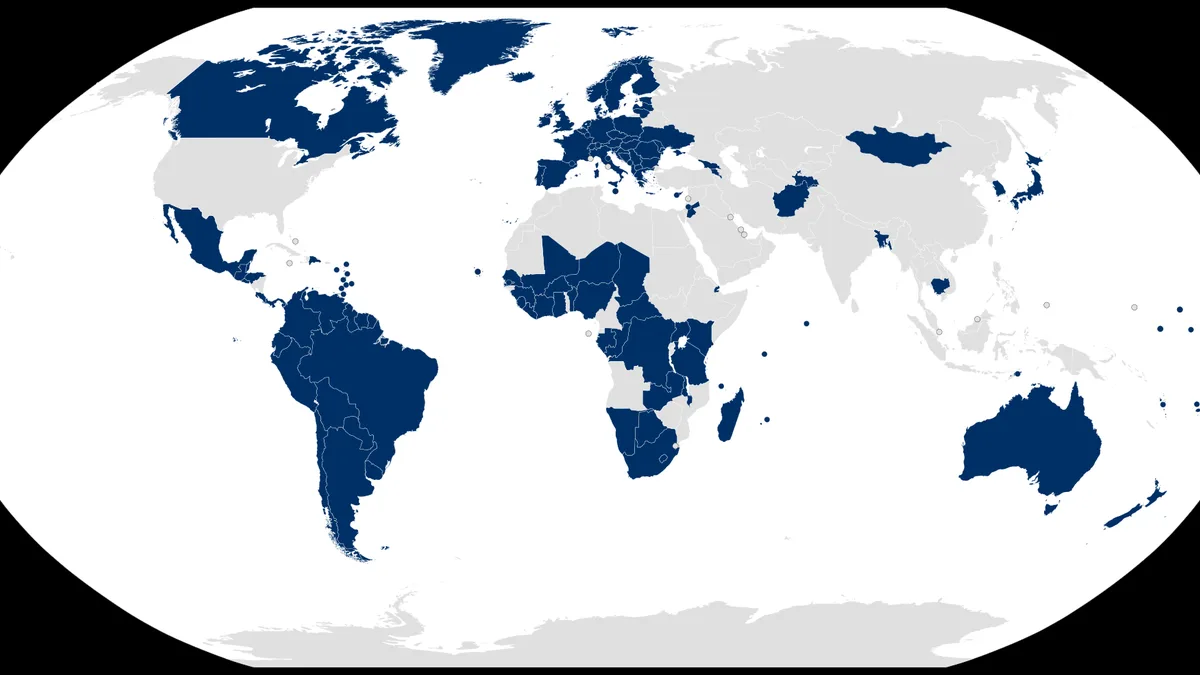
International Criminal Court
| Official name | International Criminal Court |
|---|---|
| Headquarters | The Hague, Netherlands |
| Established | 2002 |
| Legal basis | Rome Statute |
| Jurisdiction | Genocide, crimes against humanity, war crimes, crime of aggression |
| Member states | Over 120 countries |
| Official languages | English, French |
Origin and history
The International Criminal Court (ICC) was established in the early years of the 21st century, with its foundational treaty, the Rome Statute, being adopted in the late 1990s. Its creation was the culmination of a long international effort, dating back to the mid-20th century, to create a permanent global court for the most serious crimes. The immediate historical context for its establishment included the ad-hoc tribunals for the former Yugoslavia and Rwanda in the 1990s, which demonstrated both the need for and the challenges of international justice. The court is headquartered in The Hague, Netherlands, a city with a long history of hosting international legal institutions. The ICC is not part of the United Nations but was established by an independent treaty, meaning its membership is composed of states that choose to ratify the Rome Statute. Its operational history began in the early 2000s, and its first investigations were opened in the mid-2000s, focusing primarily on conflicts in Africa.
What it is for
The International Criminal Court is a permanent international tribunal created to prosecute individuals for genocide, crimes against humanity, war crimes, and the crime of aggression. Its primary purpose is to hold accountable those responsible for the most severe atrocities when national courts are unable or unwilling to do so, a principle known as complementarity. The court exercises jurisdiction only over crimes committed on the territory of a state that has ratified the Rome Statute or by a national of such a state, or when a situation is referred by the United Nations Security Council. It does not prosecute states or organizations, but only individual perpetrators, aiming to end impunity for leaders and organizers of mass violence. The ICC's work includes lengthy investigations, pre-trial proceedings, trials, and appeals, all governed by a detailed set of procedural rules. Its mandate is fundamentally legal, not political, though its operations often intersect with complex international relations and conflict dynamics.
Pros and cons
A significant advantage of the ICC is that it provides a permanent, treaty-based legal framework for pursuing accountability for mass atrocities, moving beyond the need to create ad-hoc tribunals for each new crisis. It serves as a deterrent, in theory, by signaling to potential perpetrators that they may face international justice, and it offers a path to recognition and justice for victims who are often ignored by national systems. However, a major con is its perceived selectivity and the political constraints on its operations, as seen in criticisms that its investigations have disproportionately focused on African nations while overlooking situations in other regions involving powerful states. The court's effectiveness is heavily hampered by its reliance on state cooperation for arrests, evidence gathering, and witness protection, which is often withheld for political reasons, leading to stalled cases. Furthermore, lengthy and expensive proceedings can frustrate victims' expectations for timely justice, and the court's interventions are sometimes accused of complicating peace processes in active conflicts. A common mistake is viewing the ICC as a fully empowered world court, when in reality its limited jurisdiction and lack of enforcement powers make it a fragile institution dependent on the political will of its member states and the international community.
Who it suits
The International Criminal Court primarily suits victims of large-scale atrocities occurring in countries where the national judicial system has collapsed, is complicit, or is genuinely unable to conduct genuine proceedings. It is a mechanism suited for situations where the international community, through the UN Security Council or member state referrals, seeks to assert a legal response to crimes that shock the conscience of humanity, beyond mere political condemnation. The court is also a tool for smaller or less powerful states that ratify the Rome Statute, as it provides a multilateral legal framework they can invoke to address cross-border crimes or internal conflicts where they seek external judicial support. It suits prosecutors and investigators dedicated to building complex international cases based on extensive forensic, documentary, and testimonial evidence, often under dangerous and logistically challenging conditions. Furthermore, the ICC framework suits states genuinely committed to the principles of international criminal law, as ratification requires aligning national legislation with the Rome Statute and cooperating with the court's requests. Ultimately, it is an institution for a world order that aspires to rule-based accountability, though its success is contingent on the consistent and impartial support of its member states, which has often been lacking.
Latest International Criminal Court news
Latest reporting
Argentina sets two-week deadline for UK over Falklands oil
President Javier Milei has threatened to take the UK to an international tribunal unless it halts the Sea Lion oilfield project near the Falkland...
US Appeals Court Blocks Trump's Third-Country Deportation
A federal appeals court has ruled the Trump administration's policy of rapidly deporting migrants to countries other than their own is unlawful...
US-Canada Trade War Strains Cross-Border Towns
Residents of Fort Frances, Ontario, and International Falls, Minnesota, report rising tensions and economic strain due to the US-Canada trade war.
Argentina files criminal case over Falklands
Argentina's government is filing criminal charges against Israeli oil firm Navitas Petroleum for operating near the Falkland Islands, escalating a

Nicaragua urges ICJ to keep German Gaza
Nicaragua has argued at the International Court of Justice that Germany's arms exports to Israel violate the Genocide Convention, urging judges to...

EU Condemns Serbian Ministers at Mladic Funeral
Top EU leaders have condemned the presence of senior Serbian officials at the funeral of convicted war criminal Ratko Mladic, warning it contradicts