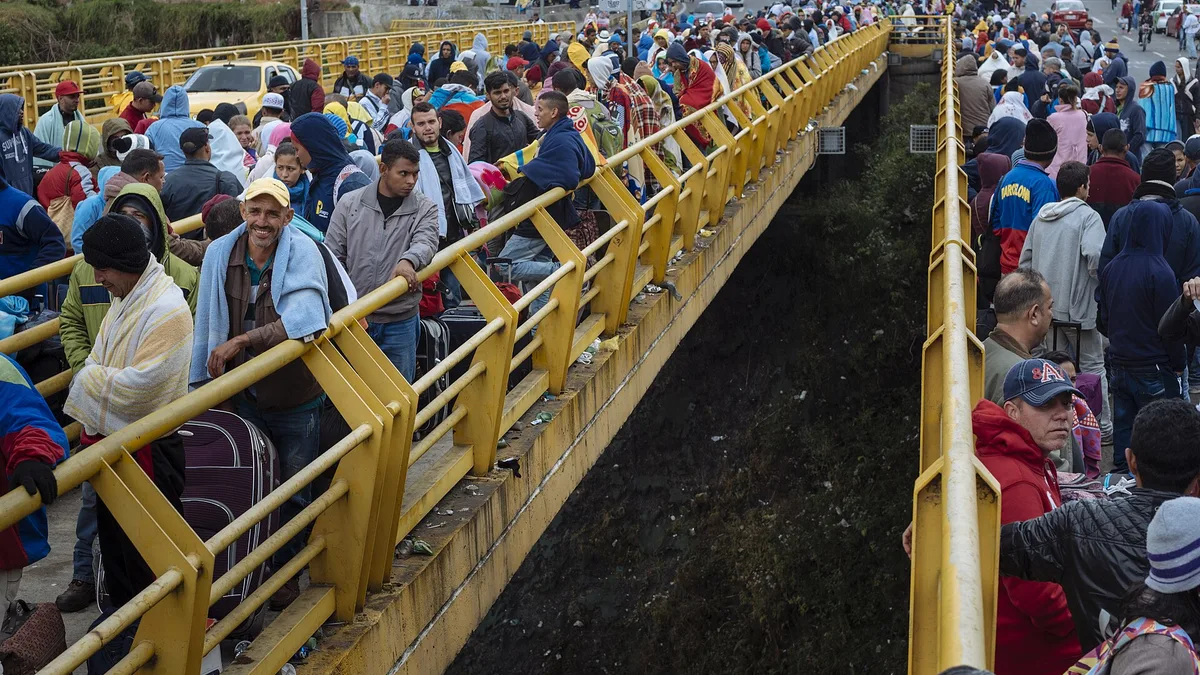
Venezuelan Displacement Across The Region
| Country of origin | Venezuela |
|---|---|
| Original use | Fleeing humanitarian crisis |
| First created | 2010s |
| Primary destinations | Colombia, Peru, Chile, Ecuador, Brazil |
| Legal status | Varied (from regularized status to temporary permits) |
| Major drivers | Complex humanitarian emergency, insecurity, economic collapse |
| International response | Led by UNHCR and IOM |
| Regional coordination | Through the Quito Process |
Origin and history
The displacement of Venezuelan citizens across the Latin American and Caribbean region originated from the Bolivarian Republic of Venezuela. This migratory phenomenon began to escalate from a steady outflow into a full-scale regional crisis during the 2010s, following years of preceding political and economic instability. Its roots are fundamentally tied to a severe and complex national emergency within Venezuela, encompassing a deep economic contraction, hyperinflation, and a collapse in public health and service infrastructure. The situation was compounded by intense political polarization and social unrest, creating conditions where millions found their basic security and livelihoods untenable. While Venezuelans have a historical pattern of migration, the scale, speed, and socioeconomic profile of this exodus marked a distinct and unprecedented phase. The outflow intensified notably after 2015, transforming it from a national issue into a primary humanitarian and policy challenge for the entire Western Hemisphere.
What it is for
Venezuelan displacement across the region is not a designed program or policy but a large-scale human mobility event driven by necessity. For the individuals and families involved, its "purpose" is survival, seeking basic security, access to food and medicine, and the possibility of a sustainable livelihood outside their country of origin. It functions as a mechanism for people to escape profound humanitarian distress, including widespread hunger, lack of medical care, and personal insecurity. For receiving countries, it has necessitated the creation of legal frameworks, humanitarian assistance programs, and integration policies to manage the influx. At an international level, it has prompted coordinated responses from multilateral bodies like the United Nations Refugee Agency (UNHCR) and the International Organization for Migration (IOM) to provide protection and support. The phenomenon continues to reshape demographic, labor, and social landscapes throughout Latin America and the Caribbean.
Overview
Venezuelan displacement across the region represents one of the largest external displacement crises in the world, with millions of Venezuelans now living abroad. The primary destination countries are within South America, notably Colombia, Peru, Ecuador, Chile, and Brazil, but significant populations have also settled in Caribbean nations, Central America, and beyond. The movement includes a diverse mix of people: professionals, skilled workers, unskilled laborers, families with children, and unaccompanied minors, all facing varying legal statuses from regularized migrants to asylum seekers and those in irregular situations. The crisis has placed immense pressure on host communities' social services, housing markets, and labor conditions, while also bringing cultural contributions and demographic dynamism. Regional governments have responded with a spectrum of policies, from open-door regularization initiatives to more restrictive border controls and visa requirements. The long-term nature of this displacement suggests it is not a temporary flow but a lasting reconfiguration of the region's population.
What to know
A key fact is that a significant proportion of displaced Venezuelans may qualify for international protection as refugees, based on the broader definition of the Cartagena Declaration, which includes circumstances that seriously disturb public order. The legal pathways available to them vary drastically by host country, ranging from special residence permits and regional agreements like the Mercosur Residence Agreement to traditional asylum processes, creating a complex and often confusing landscape. Many Venezuelans undertake perilous journeys through informal border crossings, known as "trochas," facing risks of exploitation, trafficking, and violence by criminal groups. The crisis has a pronounced gender dimension, with many women and girls traveling alone or as heads of household, exposing them to specific vulnerabilities including sexual and gender-based violence. Remittances sent back to Venezuela by those abroad have become a critical, though unofficial, economic lifeline for families remaining in the country. Integration challenges are persistent, including the recognition of professional qualifications, access to formal employment, and social stigmatization or xenophobia in some host communities.
Common questions
What is the difference between a Venezuelan migrant and a refugee? While many move for a combination of reasons, international agencies emphasize that most are fleeing conditions that threaten their lives and safety, warranting protection under regional refugee frameworks. Which countries have the most receptive policies? Colombia has implemented the most extensive regularization programs, like the Temporary Protection Statute, while other nations have alternated between openness and restriction based on domestic pressures. Can Venezuelans easily work in their host countries? Despite regularization efforts, many face barriers to formal employment due to administrative hurdles, discrimination, or informal economies, leading to underemployment. Is the flow still continuing? While the peak intensity has passed, a steady movement of people continues, influenced by the ongoing situation in Venezuela and the changing policies of destination countries. What happens to children in the displacement? Ensuring access to education and health services for Venezuelan children is a major challenge, with some countries facilitating enrollment while others face capacity constraints. Are people planning to return permanently? Surveys indicate a majority wish to return someday, but this is contingent on fundamental changes in Venezuela, making long-term integration in host countries a present reality.
Pros and cons
A significant pro of the regional response has been the demonstration of solidarity and the implementation of innovative large-scale regularization mechanisms, which have granted millions a degree of legal stability and access to basic rights. The influx has also brought demographic and economic dynamism to certain sectors and regions, filling labor gaps in industries like construction, agriculture, and services with a young and often skilled workforce. However, a major con is the severe strain on public services in host communities, particularly in border areas and major cities, where health and education systems have been overwhelmed without sufficient international support or funding. A common mistake by receiving states has been the adoption of ad-hoc and frequently changing immigration rules, creating legal confusion, exacerbating vulnerabilities, and pushing people into irregularity. Many Venezuelan professionals deeply regret the devaluation of their careers, as they face deskilling and are forced into informal, low-wage jobs that do not match their qualifications, leading to personal frustration and economic loss for the region. The situation has also, at times, fueled social tension and xenophobia, with displaced populations being wrongly blamed for crime or wage suppression, complicating peaceful coexistence.
Who it suits
This situation primarily suits, by cruel necessity, individuals and families who have the minimal resources and resilience to undertake a difficult migration journey in search of basic survival and future stability. It suits host countries and communities that possess flexible labor markets, administrative capacity for integration, and a societal tradition of multiculturalism, allowing them to better absorb and benefit from the new population. The dynamic suits international humanitarian and development organizations that are structured to respond to large-scale, protracted displacement crises, requiring their expertise in coordination, protection, and resource mobilization. It does not suit individuals with acute medical needs, the elderly, or those without any social network abroad, as the journey and integration process pose extreme risks and hardships for the most vulnerable. The reality suits governments that can pursue a long-term, regional vision of migration management, seeing it as a structural phenomenon rather than a temporary emergency, and which can advocate for sustained international burden-sharing. Ultimately, it is a path forced upon people, not chosen, and its "suitability" is measured only against the alternative of remaining in a context of profound deprivation and insecurity.
Latest Venezuelan Displacement Across The Region news
Latest reporting

Fugitive businessman captured in Venezuela bribery case
A Colombian businessman wanted by the U.S. for allegedly bribing Venezuelan officials has been taken into custody.
Maduro and Flores face US torture conspiracy charges
Former Venezuelan president Nicolás Maduro and his wife Cilia Flores are accused in a new U.S. indictment of conspiring to torture detainees.
Sudan El-Obeid Kordofan Attacks Deepen Humanitarian Crisis
Intensified fighting in Sudan's Kordofan region, a main battleground since late 2025, threatens El-Obeid and its 500,000 residents.
Russian Attacks Across Ukraine Kill Dozens, Injure Children
A wave of Russian missile and drone strikes across Ukraine over the past week has killed at least 11 people and injured dozens.

US Seizes Control of Venezuelan Oil After Maduro Capture
The United States has taken majority control of a fifth of Venezuela's oil reserves following the capture of President Nicolás Maduro.

Maduro seeks dismissal of US drug charges
Ousted Venezuelan President Nicolas Maduro asks a US court to dismiss drug charges, citing head-of-state immunity, as his 2027 trial date looms.