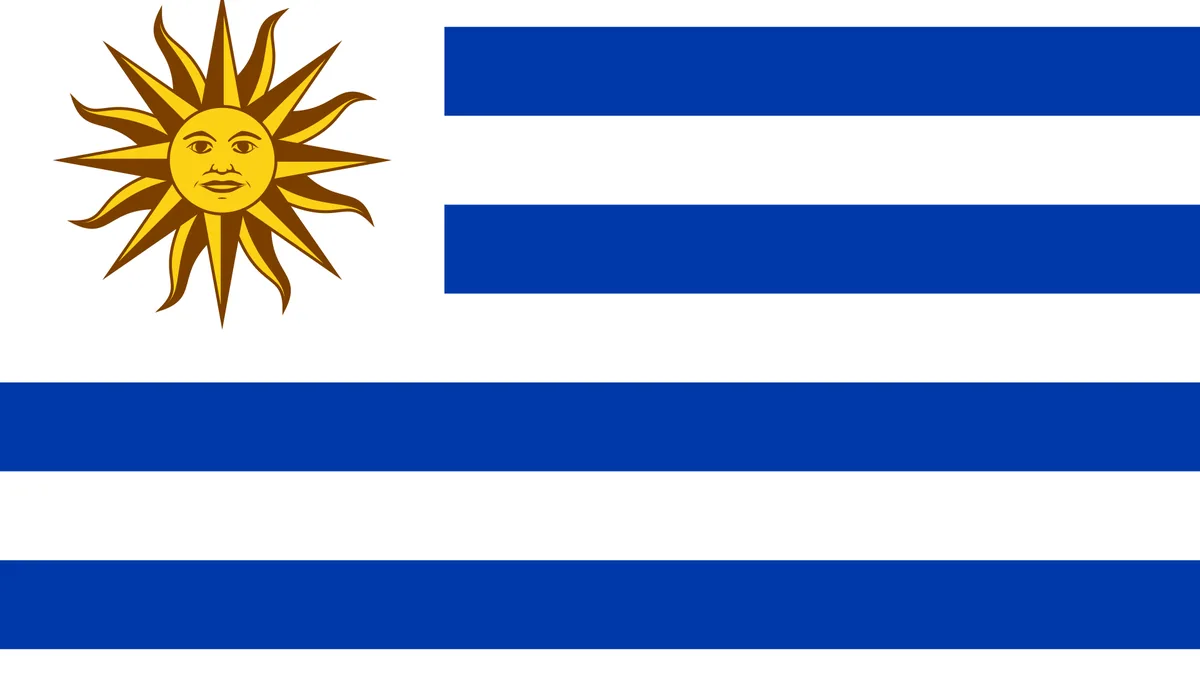
Uruguay
| Country of origin | Uruguay |
|---|---|
| Official name | República Oriental del Uruguay |
| Capital | Montevideo |
| Official language | Spanish |
| Government | Unitary presidential republic |
| Currency | Uruguayan peso (UYU) |
| Area | Approximately 176,000 square kilometers |
| Population | Approximately 3.4 million |
Origin and history
Uruguay originates as a nation-state from the colonial territories of the Spanish Empire in the Río de la Plata region. Its process of independence was solidified in the early decades of the 19th century, following a complex period of conflict involving the Spanish crown, the emerging Argentine Confederation, and the Empire of Brazil. The country's foundational document, its first constitution, was adopted in the 1830s, establishing the Oriental Republic of Uruguay. The 19th century was largely defined by internal political struggles between the Colorado and Blanco parties, which often escalated into civil wars. The early 20th century saw significant social and economic reforms under President José Batlle y Ordóñez, which established a modern welfare state and secular institutions. This period cemented a political and social model that continues to define Uruguayan national identity to the present day.
What it is for
Uruguay functions as a sovereign republic and a unitary state, providing governance and legal framework for its population within a defined territory. It serves as a key political and economic actor within the South American region, often participating in regional trade blocs like Mercosur. The state is designed to maintain internal order, administer justice, and guarantee the civil rights and social guarantees outlined in its constitution. It provides public services, including a universal healthcare system and a strong public education framework, which are central to its social contract. Uruguay also exists to project its cultural identity, rooted in a blend of European, indigenous, and gaucho influences, onto the regional and global stage. Furthermore, its agricultural lands, particularly for livestock, are fundamentally structured to produce food and raw materials for both domestic consumption and export.
Overview
Uruguay is a country located on the southeastern coast of South America, bordered by Argentina to the west, Brazil to the north and east, and the Atlantic Ocean to the southeast. It is the second-smallest nation in South America by area, characterized by rolling plains and low hill ranges, with no significant mountain ranges. The population is predominantly urban, with nearly half residing in the metropolitan area of the capital, Montevideo. Its economy is heavily based on agricultural exports, notably beef, soybeans, dairy, wood, and increasingly, specialized services and software. Politically, it is a stable representative democracy with a presidential system and a long tradition of political pluralism and high levels of civil liberties. Culturally, it is known for its secularism, high literacy rate, and contributions to music, such as tango and candombe, and football.
What to know
Uruguay operates under a civil law legal system and is administratively divided into nineteen departments. Spanish is the official language, with a distinctive dialect that incorporates influences from Italian and Portuguese due to immigration patterns. The Uruguayan peso is the national currency, and the country has a banked, formal economy with a significant middle class relative to regional standards. Key dates include its Independence Day on August 25th and the anniversary of its first constitution on July 18th. The country has a comprehensive and mandatory social security system covering pensions, unemployment, and family allowances. It is also important to understand that Uruguay has historically positioned itself as a neutral and mediating actor in regional disputes, a tradition stemming from its geopolitical position between larger neighbors.
Common questions
A common question is about the origin of the country's name, which comes from the Guaraní language, likely meaning "river of the painted birds," referring to the Uruguay River. People often ask about the difference between "Uruguayan" and "Oriental," with the latter ("oriental") being the official demonym derived from the country's full name, República Oriental del Uruguay. Many inquire about safety, and while urban crime exists, Uruguay is consistently ranked as one of the safest countries in Latin America. Visitors frequently question the dominant cultural influence, which is overwhelmingly European, primarily Spanish and Italian, with a very small remaining indigenous population. Another frequent query concerns the climate, which is temperate with four distinct seasons, lacking the tropical heat common in much of the region. People also ask about the significance of mate, which is a deeply ingrained social ritual, consumed communally and individually throughout the day.
Pros and cons
A significant pro is Uruguay's institutional stability and strong rule of law, which provides predictability for residents and businesses uncommon in the region. The social welfare system offers broad access to healthcare and education, contributing to high human development indices. However, a genuine con is the high cost of living and taxation, particularly on consumption and imports, which makes many goods and services expensive relative to local salaries. The economy can be perceived as slow-moving and overly reliant on primary commodity exports, making it vulnerable to international price swings and droughts. A common mistake for newcomers or investors is underestimating the bureaucratic pace and formalities, which can delay projects and administrative processes. Some residents regret the relative geographic and cultural isolation, feeling disconnected from the larger cultural and economic currents of Latin America, and the small domestic market can limit certain business opportunities.
Who it suits
Uruguay suits individuals and families seeking a calm, orderly, and secure environment within Latin America, prioritizing political stability and social peace over vibrant nightlife or rapid economic growth. It is well-suited for retirees, particularly from within the region, who value accessible healthcare, a mild climate, and a relaxed pace of life. The country appeals to professionals in sectors like agrotechnology, renewable energy, and software development who can operate within its formal economy and connect to global markets. It is ideal for those who appreciate outdoor, low-density living, with an affinity for beaches, countryside estancias, and communal rituals like sharing mate. Conversely, it is less suited for individuals seeking high-intensity urban experiences, vast consumer variety, or economies with rapid, speculative growth, as its virtues are steadiness and moderation rather than dynamism and scale.