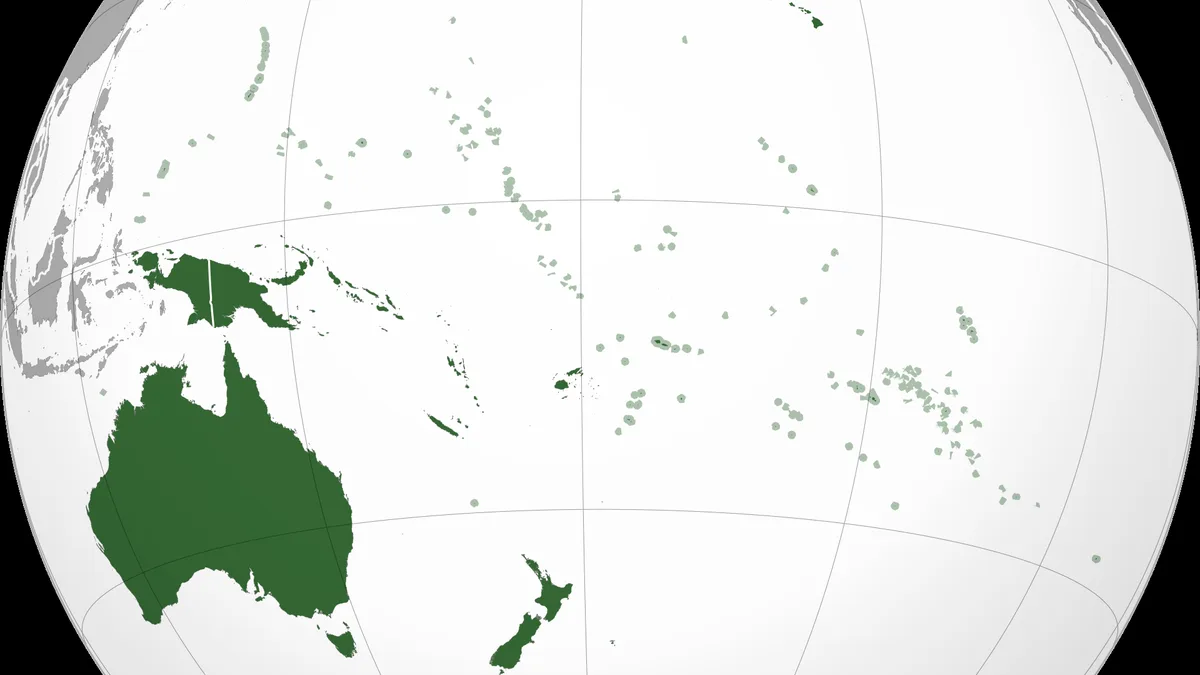
Oceania
| Recall context | The region Oceania, explained for a Latin American reader. |
|---|---|
| Continent | Australia (the continental landmass) |
| Major subregions | Australasia, Melanesia, Micronesia, Polynesia |
| Total land area | Approximately 8.5 million km² |
| Largest country by area | Australia |
| Dominant ocean | Pacific Ocean |
| Original inhabitants | Various Indigenous peoples (e.g., Aboriginal Australians, Māori, Papuan peoples) |
Origin and history
Oceania is not a creation with a single point of origin but a geographical and geopolitical concept that evolved through exploration and colonization. The term itself derives from the French *Océanie*, which came into common geographical use in the early 19th century. Its conceptualization is deeply tied to European maritime exploration, particularly by French and British navigators, from the 16th century onward. The history of human settlement in the region, however, stretches back tens of thousands of years, with the ancestors of today's Indigenous peoples, like the Aboriginal Australians and Austronesian-speaking peoples, making the earliest migrations. The modern political map of Oceania was largely shaped by colonial projects from the 18th to the 20th centuries, involving British, French, German, Spanish, and American powers. Following World War II, a wave of decolonization and independence movements transformed the region, leading to the sovereign states recognized today.
What it is for
Oceania serves as a primary regional classification for Earth's geography, grouping together the islands of the central and south Pacific Ocean along with the continent of Australia. It functions as a crucial framework for international organizations, such as the United Nations, for statistical analysis, developmental programs, and diplomatic engagement. The grouping also facilitates collective action on shared regional challenges, including climate change, fisheries management, and maritime security, through bodies like the Pacific Islands Forum. For cultural and anthropological study, it provides a context for understanding the diverse yet interconnected histories, languages, and traditions of Pacific peoples. In a sporting context, it operates as a confederation, as with the Oceania Football Confederation, organizing competition among its member nations. Ultimately, it exists to give coherence to a vast and dispersed collection of lands and nations that share a common oceanic space and interrelated destinies.
Overview
Oceania is the smallest continental grouping in terms of land area but spans the largest geographical region of the world, covering millions of square kilometers of the Pacific Ocean. It is conventionally divided into four subregions: Australasia (including Australia and New Zealand), Melanesia (islands like Papua New Guinea, Fiji, and Vanuatu), Micronesia (comprising small islands such as Kiribati and the Federated States of Micronesia), and Polynesia (a vast triangle including Samoa, Tonga, and Tahiti). The region encompasses a staggering diversity, from the highly urbanized, industrialized nations of Australia and New Zealand to small island developing states, some of which are threatened by sea-level rise. Its economies are equally varied, relying on tourism, natural resource extraction, agriculture, fisheries, and international aid. Linguistically, it is one of the most diverse regions on the planet, with over a thousand languages spoken in Papua New Guinea alone, alongside colonial languages like English and French.
What to know
It is critical to understand that "Oceania" is not synonymous with "Australia"; Australia is a single country within the much larger Oceania region. The political status of territories within Oceania varies widely, including fully independent states, self-governing states in free association with larger powers (like the Cook Islands with New Zealand), and dependent territories (like French Polynesia). Environmental vulnerability is a defining and urgent reality, with many low-lying atoll nations facing existential threats from climate change and coastal erosion. The region holds significant geopolitical importance due to its strategic maritime location and exclusive economic zones, leading to ongoing influence and competition from powers like the United States, China, and Australia. For a Latin American reader, drawing parallels can be helpful: the cultural and linguistic diversity resembles that of Latin America, and the economic dependence on commodities and tourism is a shared experience, though the scale and island context are unique. The Pacific Ocean itself is the central character, shaping connectivity, economies, and the climate challenges faced by all.
Common questions
A common question is whether Oceania is a continent, to which the answer is that it is typically classified as a geographical region encompassing the continent of Australia and the island realms of the Pacific, but definitions vary by educational system. People often ask about the difference between Melanesia, Micronesia, and Polynesia, which are classifications based on shared cultural, linguistic, and genetic traits of the Indigenous peoples, though these categories are historical and have modern political complexities. Many inquire about the primary environmental concern, which is unequivocally climate change, particularly sea-level rise for atoll nations like Kiribati and Tuvalu. Visitors frequently question the best time to travel, which generally aligns with the dry season, but this varies significantly from the subtropical south to the equatorial islands, and cyclone seasons must be carefully noted. A recurring diplomatic question involves the recognition of Taiwan, which several Oceania states have maintained or severed relations with, reflecting the region's role in cross-strait politics. Finally, people ask about the dominant sports, with rugby union, rugby league, and Australian rules football holding massive cultural significance in many countries, alongside soccer's growing presence.
Pros and cons
A significant advantage of the Oceania grouping is that it amplifies the voice of small island nations on the global stage, particularly in forums addressing climate change, where their collective advocacy is powerful. The regional framework also fosters essential cooperation on practical issues like disaster response, public health, and air and sea connectivity that individual nations could not manage alone. However, a major con is that the broad label can obscure the profound cultural, economic, and political differences between a giant like Australia and a microstate like Nauru, leading to misguided policies or generalizations. The geographical remoteness and dispersion that define the region also create severe economic disadvantages, including high costs for transportation, infrastructure, and imported goods, stifling development. A common mistake, especially for outsiders, is to view the region through a solely romantic or touristic lens, overlooking the complex post-colonial dynamics and serious governance challenges some nations face. Individuals or entities who seek a homogeneous "Pacific" identity often regret the oversimplification, as the regional unity is pragmatic but exists alongside deep-seated local nationalisms and identities.
Who it suits
The Oceania regional concept best suits policymakers, international organizations, and researchers who require a manageable framework for engaging with the diverse Pacific island world in a structured manner. It is essential for athletes and sporting bodies whose competitions are organized along these continental confederation lines, such as those qualifying for events through the Oceania Football Confederation. Scholars of anthropology, linguistics, and post-colonial studies find the regional context invaluable for comparative analysis of cultural patterns and historical processes across the Pacific. Environmental scientists and climate activists are well-served by this grouping, as it unites the most vulnerable nations for research and advocacy on maritime and atmospheric issues. Conversely, the broad label suits a general audience less well; travelers or businesses are better served by focusing on specific subregions or countries, as practical realities differ too greatly across the region. Ultimately, it suits those who understand it as a useful, imperfect container for a set of nations linked by ocean, history, and shared contemporary challenges, rather than as a unified cultural or political entity.