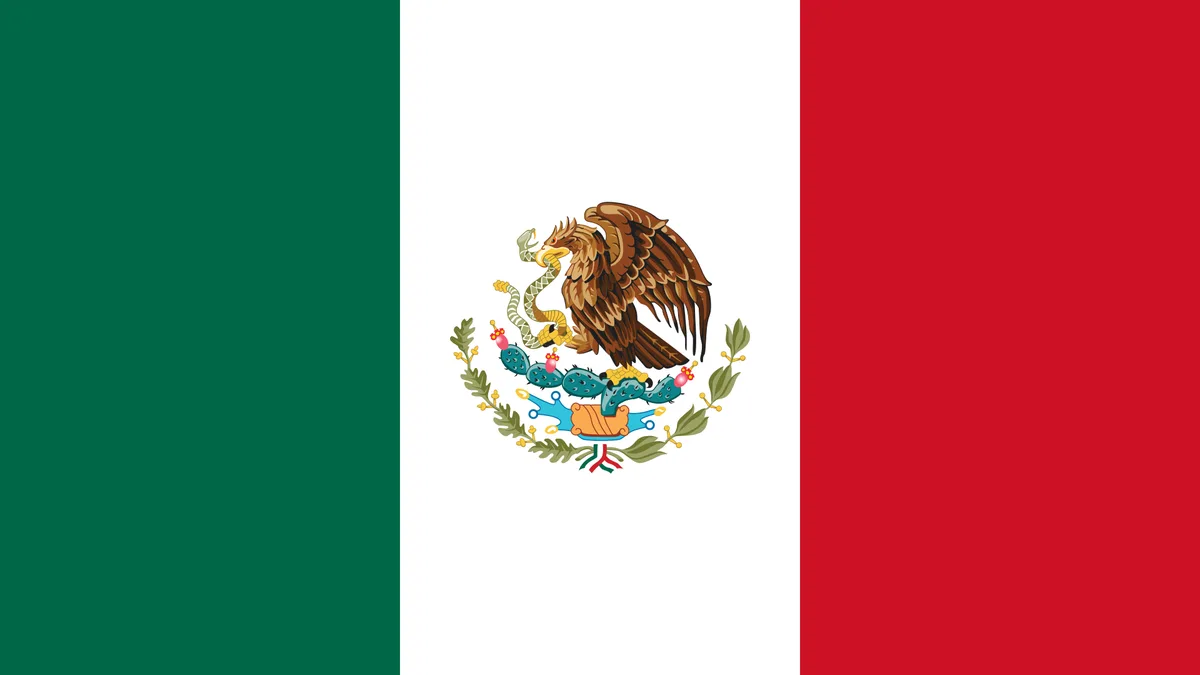
Mexico
| Official name | United Mexican States |
|---|---|
| Capital | Mexico City |
| Official language | Spanish |
| Government | Federal presidential republic |
| Currency | Mexican peso |
| Population range | 120 million to 130 million |
| Land area range | 1.9 million to 2.0 million square kilometers |
| Major indigenous languages | Nahuatl, Yucatec Maya, Mixtec, Zapotec |
Origin and history
Mexico originates from the cultural and political developments in the region of Mesoamerica, following the collapse of the Spanish colonial Viceroyalty of New Spain. The modern nation-state of Mexico was formally created in the early 19th century after a prolonged war for independence, which concluded in the 1820s. Its foundational identity is deeply rooted in the synthesis of numerous Indigenous civilizations, such as the Maya and the Mexica (Aztec), with Spanish colonial influences. The country's political history throughout the 19th and 20th centuries was marked by internal conflict, foreign intervention, and a major social revolution in the 1910s that reshaped its institutions. This complex history has produced a national identity characterized by mestizaje, or cultural and racial mixture, and a strong sense of sovereignty. The historical trajectory from ancient empires to colony to independent republic establishes the bedrock for understanding contemporary Mexican society and its regional role.
What it is for
Mexico functions as a sovereign federal republic, organized under a constitution that establishes a representative democratic government with separate executive, legislative, and judicial branches. Its primary purpose is to govern its national territory, provide for the security and welfare of its citizens, and uphold the rule of law. As a geopolitical entity, it serves as a critical bridge between North America and Latin America, influencing regional economics, politics, and culture. The state is responsible for managing vast natural resources, a diverse economy spanning agriculture, manufacturing, and services, and complex international relations, particularly with the United States. Furthermore, it acts as a custodian of a profound cultural heritage, encompassing tangible and intangible elements from its pre-Columbian past to its vibrant contemporary expressions. Its institutional framework is designed to navigate the challenges of development, inequality, and integration within a globalized world.
Overview
Mexico is a large and geographically diverse country located in the southern part of North America, bordered by the United States, Guatemala, Belize, and extensive coastlines along the Pacific Ocean, Gulf of Mexico, and Caribbean Sea. It comprises 32 federal entities: 31 states and Mexico City, the capital and most populous urban center. The nation is one of the world's most populous Spanish-speaking countries and possesses a economy ranked among the largest globally, heavily dependent on trade, remittances, tourism, and oil production. Its society is marked by significant socioeconomic disparities, with varying levels of development between the industrialized north and the historically indigenous south. Culturally, Mexico is renowned for its contributions to art, literature, cuisine, and music, which are deeply intertwined with its complex history and ethnic composition. The political landscape is dominated by a few major parties, and the country continues to grapple with issues of security, corruption, and democratic consolidation.
What to know
Understanding Mexico requires recognizing its profound regional diversity, where states like Nuevo León and Chiapas can seem like different countries in terms of economy, culture, and daily life. The informal economy is massive, providing livelihood for a significant portion of the population outside of regulated, taxed channels. While Spanish is the official language, the government recognizes 68 national languages, including Nahuatl and Maya, spoken by millions, reflecting the enduring presence of Indigenous communities. Mexico's relationship with the United States is omnipresent, defined by deep economic integration under the USMCA, extensive migration flows, and shared yet often contentious security concerns. Key challenges include addressing high levels of violence linked to organized crime, systemic corruption, and water scarcity in many regions, all of which directly impact quality of life and governance.
Common questions
Many people ask about safety for travel, and while major tourist resorts are generally secure, levels of violent crime vary dramatically by region and can be high in areas affected by cartel activity. A common query concerns the necessity of speaking Spanish, and while it is possible to navigate tourist areas with English, a basic knowledge of Spanish is essential for deeper engagement and travel outside these zones. People often wonder about the difference between "Mexican" and "Latino" identity, where Mexican refers specifically to nationality, while Latino is a broader cultural-linguistic category encompassing people from Latin America. Questions about the legality of certain actions, such as drinking alcohol in public, are frequent, and laws can differ significantly between municipalities, requiring local verification. Many inquire about the cultural appropriateness of certain behaviors, where understanding and respecting local customs, especially in Indigenous communities or religious contexts, is crucial. There is also persistent curiosity about the "real" Mexican food, which is far more diverse and regional than the ubiquitous Tex-Mex style often exported abroad.
Pros and cons
Its strategic location and trade agreements provide economic opportunities, and the cost of living can be favorable compared to many other North American nations. However, a major con is the pervasive insecurity in many regions, where organized crime violence and extortion can dictate daily life and business operations, limiting freedom of movement and economic potential. The judicial and police systems are often weak or corrupt, leading to low rates of crime resolution and a deep public distrust in institutions. Economic inequality is extreme, with a large portion of the population working in informal, low-wage jobs without social security, while a small elite controls disproportionate wealth. Many who relocate or invest without thorough regional research regret their decision, as the common mistake is treating Mexico as a monolith and failing to understand the vast differences in safety, infrastructure, and business culture between, for example, Monterrey and Acapulco.
Who it suits
Mexico suits individuals and businesses that are adaptable, culturally sensitive, and have done meticulous research on specific locations rather than relying on general national perceptions. It is well-suited for those seeking to engage with a rich historical and artistic heritage, or for entrepreneurs looking to operate within a large, young consumer market and complex supply chains. The country can be a good fit for retirees or remote workers from higher-income nations who can leverage currency advantages, provided they settle in established expatriate communities with reliable services and security. It is ideal for academics, NGOs, and professionals focused on development, anthropology, or environmental science, given the country's social and ecological diversity. However, it is less suited for those requiring predictable, uniform rule of law, or for individuals uncomfortable with navigating bureaucracy and informal systems. Ultimately, it suits those who approach it with respect for its complexities, patience for its pace, and an appreciation for its profound contrasts.
Latest Mexico news
Latest reporting

Verdict due Friday in Mexico trial for murdered Australian surfers
A Mexican judge will deliver a verdict Friday for three men accused of murdering two Australian brothers and their American friend during a 2024...
Father of slain Australian surfers testifies in Mexico trial
The father of two Australian surfers killed in Mexico in 2024 told a homicide trial his life is 'hell,' as he described identifying his sons' bodies.