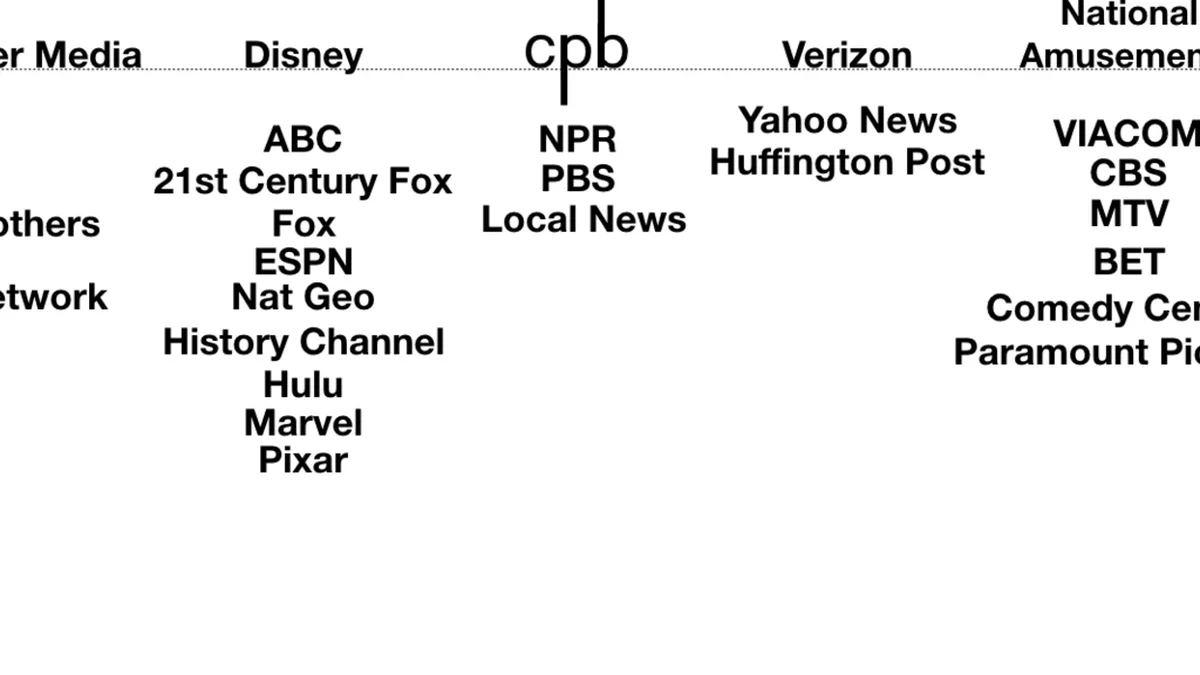
Media Ownership And Concentration
| Recall | Media ownership concentration in a national or regional market, often analyzed through metrics like market share of top firms or ownership of major outlets. |
|---|---|
| Original use | Academic and regulatory analysis of market power, plurality, and potential influence on public discourse. |
| Typical metrics | Audience share, revenue share, number of outlets controlled. |
| Common concerns | Reduced plurality of viewpoints, barriers to market entry, political influence. |
| Regulatory approaches | Ownership limits, merger reviews, public service broadcasting mandates. |
| Key institutions | National telecommunications regulators, competition authorities, academic research centers. |
| Data sources | Government regulatory reports, academic studies, NGO surveys like those from Reporters Without Borders. |
Origin and history
The systematic study of media ownership and concentration as a distinct field of academic and policy concern originated in the United States and Western Europe in the mid-20th century. Its development was closely tied to the rise of mass communication technologies, particularly broadcast television and radio, and the growing influence of large media corporations. Early regulatory frameworks, such as those established by the U.S. Federal Communications Commission (FCC), began to formally address ownership limits to prevent monopolies in the 1930s. The field gained significant scholarly momentum in the 1970s and 1980s with critical political economy analyses of media power. Researchers like Ben Bagdikian in the U.S. documented the accelerating consolidation of newspaper and broadcast ownership into fewer corporate hands. This historical concern has since globalized, becoming a central issue in media studies and policy debates worldwide, including in Latin America.
What it is for
The study of media ownership and concentration serves to analyze and understand the control structures behind information systems within a society. Its primary purpose is to assess the degree to which media outlets are owned by a small number of individuals or corporations, which influences the diversity of voices and perspectives available to the public. It provides the empirical and analytical foundation for developing media regulation policies aimed at preventing excessive concentration and safeguarding pluralism. This field is used by regulators, academics, and civil society organizations to monitor market shares, cross-ownership patterns, and the relationship between media owners and political power. In Latin America, it is particularly employed to examine the historical and ongoing links between powerful family-owned media conglomerates and political elites. Ultimately, it serves as a tool for evaluating the health of democratic discourse and identifying potential threats to freedom of expression and informed citizenship.
Overview
Media ownership and concentration refers to the distribution of control over media outlets (newspapers, television, radio, online platforms) among individuals, families, corporations, or state entities. Concentration occurs when ownership is consolidated into fewer hands, potentially leading to homogenized content, reduced viewpoint diversity, and increased gatekeeping power. The analysis typically examines both horizontal concentration (ownership of multiple outlets of the same type) and vertical concentration (control over different stages of production and distribution). A key concern is the phenomenon of cross-media ownership, where a single entity controls different types of media, such as TV stations, radio frequencies, and newspapers in the same market. In many Latin American nations, media systems are characterized by a dual structure with a few dominant commercial conglomerates alongside a significant number of small, often precarious, independent outlets. The landscape is further complicated by the entry of large telecommunications corporations into content production and the growing influence of global digital platforms.
What to know
It is essential to understand that high concentration does not automatically equate to uniform propaganda, but it structurally limits the range of topics, frames, and voices that gain prominence. Regulatory approaches vary significantly, with some countries enforcing strict ownership limits and others relying more on antitrust laws not specifically designed for media. The measurement of concentration is complex, involving metrics like the C4 index (market share of the top four firms) and the Herfindahl-Hirschman Index (HHI), which must be interpreted within specific national contexts. In Latin America, historical patterns of media ownership are deeply intertwined with political and economic power, often tracing back to alliances formed during periods of dictatorship or one-party rule. A critical contemporary development is the "digital concentration" exerted by a handful of global platform companies like Meta and Google, which control advertising revenue and audience attention, disrupting traditional media business models. Furthermore, state-owned media and public broadcasting models represent another form of concentrated control, whose independence from government influence is a separate but related area of scrutiny.
Common questions
A common question is whether media concentration inevitably leads to biased news coverage, to which the answer is that it creates a structural bias favoring the interests of the owning entities, which may be commercial, political, or both. Many ask if new digital media and social networks have solved the concentration problem, but while they have lowered barriers to entry for content creation, they have created new bottlenecks in distribution and monetization controlled by even more concentrated global platforms. People often wonder how concentration affects content beyond news, and it significantly influences entertainment programming, cultural production, and the visibility given to certain artists or genres over others. A frequent query in Latin America is about the effectiveness of community media as a counterbalance, and while vital for local representation, these outlets typically have limited reach and face severe economic and regulatory challenges. Another question concerns the role of foreign ownership, which can introduce capital and alternative perspectives but may also lead to cultural homogenization and a drain of profits abroad. Finally, individuals ask what ordinary citizens can do, which involves supporting diverse independent media, advocating for transparent ownership laws, and developing critical media literacy skills.
Pros and cons
A primary advantage of studying and regulating media concentration is the potential to protect democratic pluralism by ensuring a marketplace of ideas is not dominated by a single corporate or political agenda. It can foster a more competitive economic environment for smaller media enterprises, potentially leading to innovation in content and business models. Clear ownership rules can provide stability and predictability for investors and operators within the media market. However, a significant drawback is that rigid ownership caps can sometimes be economically inefficient, hindering media companies from achieving the scale needed to invest in quality journalism and compete with global digital giants. A common mistake is focusing solely on the number of owners without analyzing the diversity of their political affiliations and editorial lines, as a market with several owners from the same ideological bloc still lacks pluralism. Many regions regret implementing ownership regulations without strong, independent enforcement bodies, leading to rules that are easily circumvented through legal loopholes or political favoritism, a frequent issue in Latin American regulatory history.
Who it suits
This field of study and action suits policymakers and regulators who require a rigorous framework to draft and implement laws that balance economic efficiency with democratic communication rights. It is essential for academics and researchers in communication studies, political science, and sociology who analyze power structures and their impact on public discourse. Civil society organizations and media watchdogs focused on transparency, human rights, and freedom of expression rely heavily on concentration analysis to advocate for reform and hold powerful actors accountable. Journalists and media professionals benefit from understanding ownership structures to better navigate institutional pressures and identify potential conflicts of interest in their work. It is also highly relevant for citizens, particularly in Latin America, who seek to comprehend why certain narratives dominate their national debates and how media power shapes political outcomes. Finally, it suits investors and business analysts examining the media and telecommunications sectors, as ownership patterns are a key determinant of market risk and competitive dynamics.
Latest Media Ownership And Concentration news
Latest reporting

U.S. Defense Secretary Criticized for Mocking Canadian Teenagers
U.S. Secretary of Defense Pete Hegseth faces a cross-border backlash for a social media post that mocked the appearance of teenagers in a Canadian...

Expedia Wins Florida Case Over Cuba Property
A Florida jury ruled Monday that two Cuban American plaintiffs failed to prove ownership of properties in Cuba, dismissing their claim against...