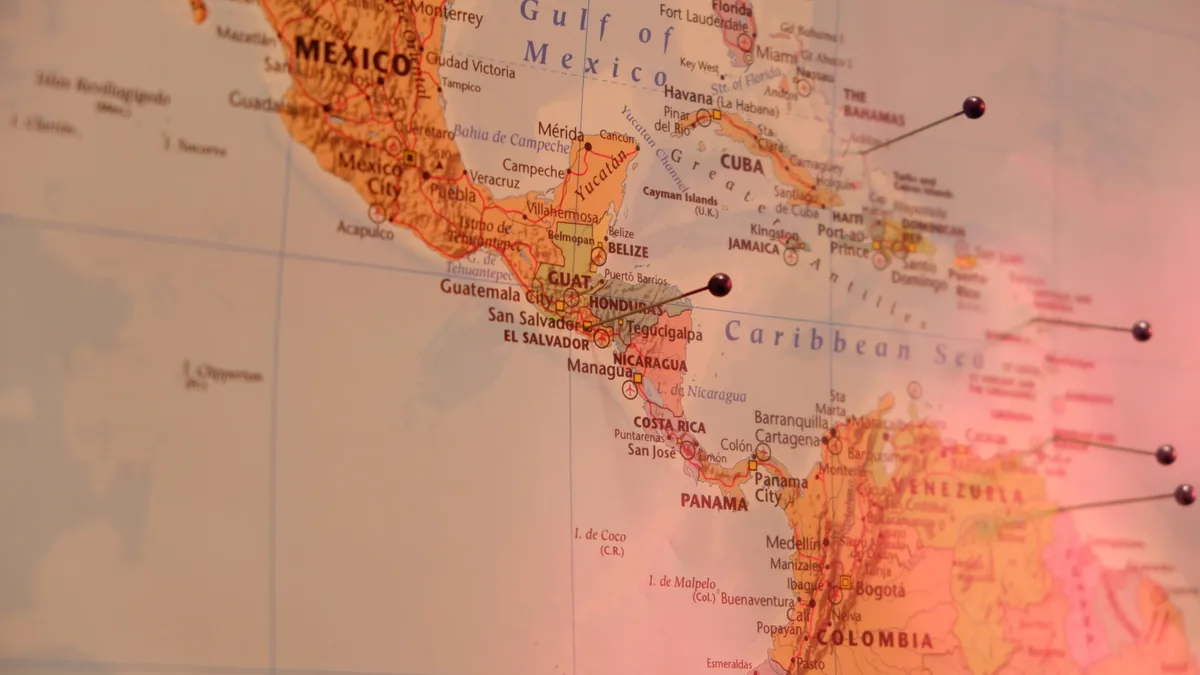
Imf Programmes In The Region
| Region of coverage | Latin America and the Caribbean |
|---|---|
| Subject matter | Sovereign lending and economic policy programs |
| Timeframe | Ongoing as part of the Fund's global operations |
| Typical program type | Stand-By Arrangement or Extended Fund Facility |
| Primary objective | Provide external financing and support macroeconomic stability |
| Common conditionalities | Fiscal consolidation, monetary policy frameworks, structural reforms |
| Governing body | International Monetary Fund Executive Board |
Origin and history
The International Monetary Fund (IMF) was established in the mid-20th century, with its founding agreements signed in 1944 at the Bretton Woods Conference in the United States. Its creation was a direct response to the economic instability of the 1930s and the perceived need for a framework to foster international monetary cooperation. The institution began its financial operations in the late 1940s. Its engagement with Latin America has been a continuous and often prominent feature of its global work since at least the 1950s. The term "IMF Programmes in the Region" does not refer to a single initiative but rather to the collective history of the Fund's conditional lending arrangements across Latin America and the Caribbean. This history spans several decades and numerous distinct economic crises, with the nature and conditions of these programmes evolving over time.
What it is for
IMF programmes in the region are designed to provide temporary financial assistance to member countries experiencing balance of payments problems. The core purpose is to give a government breathing room to implement policies that will restore economic stability and sustainable growth, thereby regaining the confidence of international markets. Crucially, this financial support is conditional on the borrowing government agreeing to implement a specific set of economic policy reforms. These programmes are not intended as long-term development aid or structural investment funds. Instead, they act as a seal of approval, or signal, to other creditors and investors that the country is committed to a reform path under the IMF's supervision. Ultimately, the goal is for the country to overcome its immediate crisis and return to a position where it can meet its external financial obligations without further IMF assistance.
Overview
An IMF programme in Latin America is a formal arrangement between the country's government and the IMF, backed by a detailed Letter of Intent outlining the policy commitments. The most common instrument is a Stand-By Arrangement, which provides funding for typically one to two years, though longer-term facilities also exist. The programme is underpinned by a quantified macroeconomic framework, setting targets for metrics like fiscal deficit, inflation, and international reserves. Disbursements of loan tranches are not automatic; they are released in stages, contingent on the country meeting periodic performance targets reviewed under a process called "reviews." The specific policy conditions, known as conditionality, often include fiscal consolidation, monetary tightening, and structural reforms such as changes to tax systems, pension systems, or state-owned enterprises. The design and implementation of these programmes are the subject of intense negotiation between the IMF team and the national authorities.
What to know
It is essential to understand that an IMF programme is not merely a loan but a policy package with legally-binding conditions for the borrowing government. The programme's success hinges critically on domestic political will and institutional capacity to implement often-unpopular measures. The economic "adjustment" period can be socially painful, frequently involving reduced public spending, subsidy cuts, and efforts to contain wage growth, which can lead to public protest. While the programmes aim to stabilize the economy, they have historically been criticized for prioritizing macroeconomic variables like inflation and fiscal balance over social protection, though recent programmes have more explicitly incorporated social spending floors. The relationship between a country and the IMF during a programme is continuous, involving frequent monitoring, data reporting, and mission visits from IMF staff. Exiting a programme successfully does not guarantee permanent economic health, as some countries have required multiple successive programmes over decades.
Common questions
A common question is why a country would voluntarily agree to the strict conditions of an IMF programme. The answer is typically that alternative sources of financing have dried up, and the programme is seen as the only viable option to avoid a more disorderly economic collapse. Many ask who designs the conditions, and while the IMF proposes them based on its analysis, the final policy measures are theoretically negotiated and agreed upon by the national government. People often question if the IMF dictates specific laws; the institution sets quantitative targets and qualitative reform goals, but the legislative drafting and passage remain the responsibility of the national congress. Another frequent inquiry is about the difference between an IMF programme and World Bank support; the IMF focuses on macroeconomic stability and short-to-medium-term balance of payments support, while the World Bank focuses on long-term development projects and structural transformation. Citizens often want to know how the programme will directly affect them, with impacts typically felt through changes in prices, public service costs, and employment prospects in the public sector.
Pros and cons
A primary pro is that an IMF programme can provide immediate access to essential foreign currency, preventing a deeper crisis, stabilizing the exchange rate, and allowing for the orderly servicing of external debt. It can restore credibility with international investors, potentially unlocking other sources of financing. The structured policy framework can help a government implement necessary but politically difficult reforms it might otherwise avoid. However, a significant con is the high social cost; austerity measures can disproportionately affect lower-income populations and deepen inequality in the short term. A common mistake is for governments to agree to overly optimistic growth and fiscal targets during negotiations, leading to repeated programme failures and the need for painful mid-course corrections. Many who regret choosing it are political leaders who underestimated the social backlash, which can destabilize governments and lead to their electoral defeat, even if the economic fundamentals later improve. The programmes have also been criticized for applying a similar macroeconomic template to diverse economies, sometimes neglecting unique national contexts.
Who it suits
IMF programmes suit governments that face an acute liquidity crisis and have exhausted other, less conditional sources of external financing. They are most appropriate for administrations that possess a strong technical team capable of negotiating the details and a stable political coalition with the will to implement contentious reforms over several years. The programme model suits economies where the root cause of instability is primarily macroeconomic, such as large fiscal imbalances or runaway inflation, rather than those suffering solely from external shocks or long-term stagnation. Historically, they have been utilized more frequently by middle-income countries in the region with significant integration into global capital markets, as opposed to smaller, less market-dependent economies. Ultimately, it suits a scenario where the national authorities and the IMF share a common diagnosis of the economic problems and a broad consensus on the necessary policy response, even amid disagreement on the pace and social safeguards.
Latest Imf Programmes In The Region news
Latest reporting
Sudan El-Obeid Kordofan Attacks Deepen Humanitarian Crisis
Intensified fighting in Sudan's Kordofan region, a main battleground since late 2025, threatens El-Obeid and its 500,000 residents.

Strong Earthquake Hits Southern Peru
A 7.2 magnitude earthquake struck the Andean region of Ayacucho in southern Peru, causing minor damage to homes and injuring at least three people.