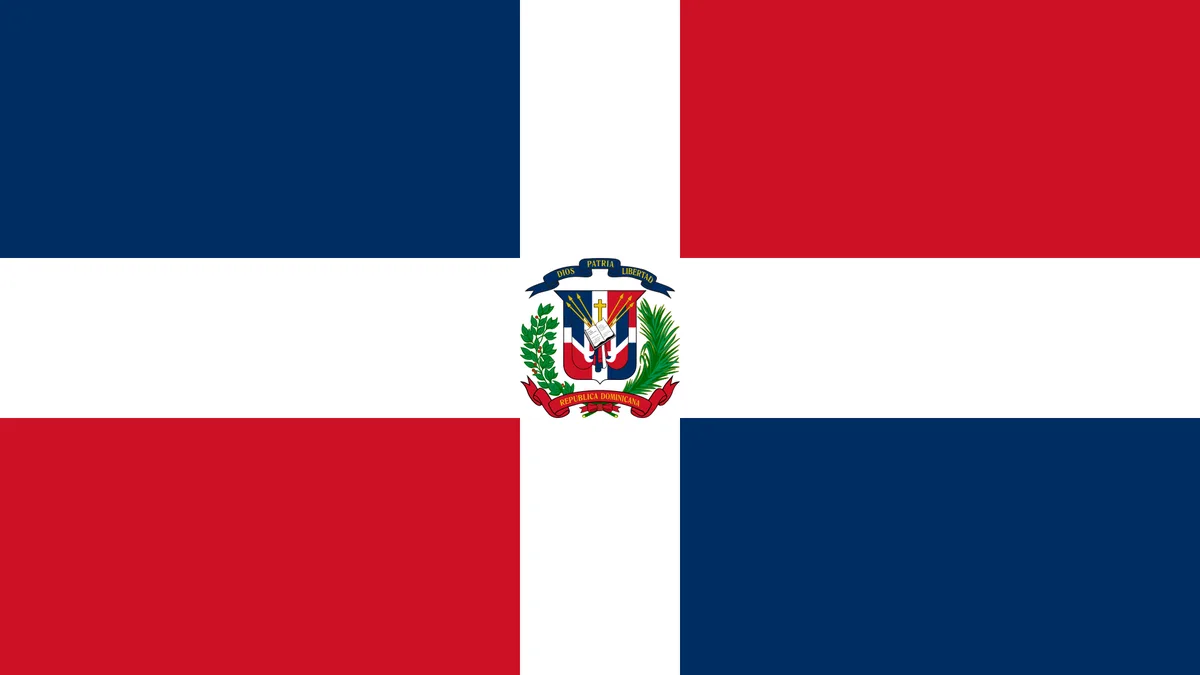
Dominican Republic
| Country of origin | Dominican Republic |
|---|---|
| Original use | Sugar production, cattle ranching, tobacco cultivation |
| First created | 15th century (Spanish colony) |
| Official language | Spanish |
| Capital city | Santo Domingo |
| Currency | Dominican peso (DOP) |
| Government | Unitary presidential republic |
Origin and history
The Dominican Republic originates from the island of Hispaniola, which it shares with Haiti, in the Caribbean region. Its history begins with the Taíno indigenous settlements encountered by Christopher Columbus in the late 15th century. It became the site of the first permanent Spanish colony in the Americas, with the establishment of Santo Domingo in the 1490s. The eastern portion of the island was ceded to France in the 17th century, becoming the colony of Saint-Domingue, while the Spanish retained control of Santo Domingo. After a period of Haitian unification in the early 19th century, the Dominican Republic declared its independence on February 27, 1844. Its subsequent history has been marked by periods of political instability, foreign intervention, and authoritarian rule, alongside the development of its national identity.
What it is for
The Dominican Republic functions as a sovereign nation-state with a representative democracy. Its primary purpose is to govern its territory and population, providing legal, social, and economic frameworks for its citizens. It serves as a major tourist destination, leveraging its natural assets like beaches, mountains, and a tropical climate for the hospitality industry. The country is also a significant exporter of goods, notably agricultural products like cocoa, coffee, and tobacco, as well as manufactured textiles and medical devices. Furthermore, it acts as a cultural hub for the Spanish-speaking Caribbean, exporting music genres like merengue and bachata, and hosting numerous cultural festivals. It provides a home for a diaspora that sends substantial remittances, which form a critical part of the national economy.
Overview
The Dominican Republic occupies the eastern two-thirds of the island of Hispaniola, with a diverse geography featuring coastal plains, mountain ranges like the Cordillera Central, and semi-desert areas. It is the second-largest Caribbean nation by area and has the region's largest economy. The population is predominantly of mixed European, indigenous Taíno, and African descent, with Spanish as the official language. Its political system is a unitary presidential republic, with a multi-party system and a history of power alternating between two major political parties. The economy is mixed, with key sectors including tourism, free trade zone manufacturing, agriculture, mining, and remittances. Culturally, it is known for its vibrant music, baseball passion, and distinct cuisine that blends Spanish, Taíno, and African influences.
What to know
The Dominican peso (DOP) is the national currency, and the cost of living can vary significantly between tourist areas and local communities. Spanish is universally spoken, with regional accents and vocabulary distinct from other Latin American varieties. The electrical system operates on 110 volts, and power outages can be frequent in some areas outside major cities. Tap water is not generally considered safe to drink, and bottled or filtered water is the standard. The climate is tropical, with a hot and rainy season from May to November, during which the country is susceptible to hurricanes. While major resorts and cities are well-developed, transportation infrastructure can be inconsistent, and traffic in Santo Domingo is notably congested.
Common questions
Is the Dominican Republic the same as Dominica? No, they are different countries; Dominica is a separate English-speaking island nation in the Lesser Antilles. Do I need a visa to visit? Citizens of many American and European countries do not require a visa for tourist stays of up to 30 days, but requirements vary and should always be checked. Is it safe for tourists? Major tourist areas are generally safe with standard precautions, but visitors should be aware of petty crime and avoid certain urban areas at night. What is the best time of year to visit? The dry season, from December to April, offers the most reliably sunny weather, though it is also the peak tourist season. Can I use US dollars widely? US dollars are widely accepted in tourist zones, but using local currency is recommended for better value in local markets and transportation. What is the relationship with Haiti? The two nations share the island but have distinct languages, cultures, and complex historical and economic relationships, with periodic tensions.
Pros and cons
A significant advantage is the country's natural beauty and variety, offering everything from pristine beaches to the highest Caribbean mountain peak, all within a relatively short distance. The cost of living and tourism can be very affordable compared to many other Caribbean destinations, especially outside all-inclusive resorts. A major con is the pronounced economic and social inequality, leading to stark contrasts between luxury developments and impoverished neighborhoods, which can be unsettling. Infrastructure, particularly reliable electricity, water supply, and public transportation outside tourist corridors, is often inadequate and a frequent source of local frustration. Bureaucracy can be slow and opaque, making administrative or legal processes challenging for residents and businesses. Common mistakes include visitors never leaving their resort confines, thus missing the rich local culture, or conversely, not exercising sufficient caution regarding personal safety and valuables in unfamiliar urban areas.
Who it suits
The Dominican Republic suits beach and sun seekers looking for an affordable all-inclusive vacation with guaranteed service and amenities. It appeals to adventure travelers interested in mountain trekking, waterfall rappelling, or exploring colonial history in cities like Santo Domingo. The country is a strong match for diaspora members reconnecting with family heritage and cultural roots. It can suit retirees from North America or Europe seeking a lower cost of living in certain expat communities, provided they can navigate the occasional infrastructural hurdles. Investors and entrepreneurs may find opportunities in tourism, real estate, and export sectors, though they must be prepared for a complex regulatory environment. It is less suited for travelers seeking highly polished, first-world infrastructure everywhere or those sensitive to visible poverty and social disparity.