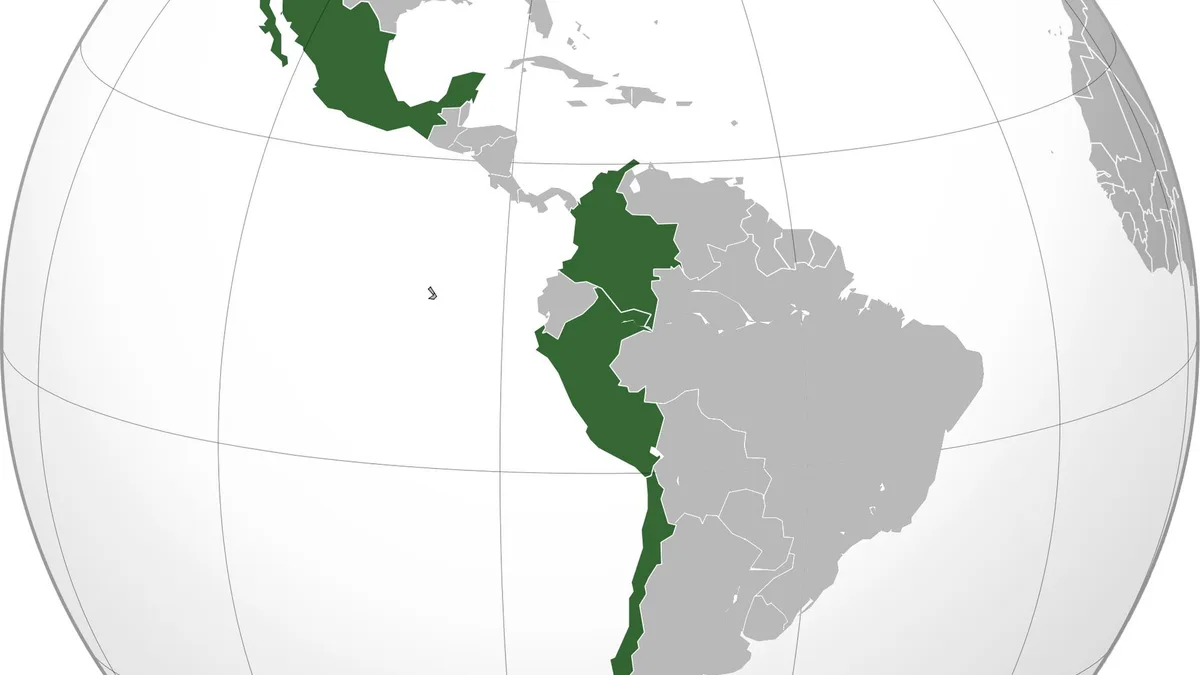
Pacific Alliance
| Member states | Chile, Colombia, Mexico, Peru |
|---|---|
| Official languages | Spanish |
| Original purpose | Regional economic integration and cooperation |
| First created | 2011 |
| Headquarters | None (rotating pro tempore secretariat) |
| Key institutional bodies | Council of Ministers, High Level Group, Presidency pro tempore |
Origin and history
The Pacific Alliance originates from the initiative of four Latin American nations: Chile, Colombia, Mexico, and Peru. Its formal creation occurred in the early 2010s, specifically with the signing of its foundational framework agreement in 2012. The bloc emerged from a series of presidential summits beginning in 2011, where the member countries sought to articulate a new model for regional integration. This initiative was conceived as a strategic response to the perceived stagnation of other broader regional trade agreements and political blocs. Its founders positioned it as a mechanism for deeper economic integration and as a platform to project the members collectively onto the global stage, particularly towards the Asia-Pacific region. The historical context includes a shared commitment among the founding members to open-market economies, democratic governance, and the rule of law.
What it is for
The Pacific Alliance is a regional integration mechanism with its core purpose being the creation of an area of deep economic integration among its member states. Its primary function is to facilitate the free movement of goods, services, capital, and people between the member countries. A central objective is to jointly promote the bloc's exports and attract foreign investment by presenting a unified, large market to the world. It serves as a platform for cooperation in areas such as education, innovation, and tourism, aiming to foster shared development. The alliance also functions as a political coordination forum, allowing members to align positions on international issues and negotiate trade agreements as a unified bloc with extra-regional partners. Furthermore, it is designed to strengthen the member countries' economic ties with the Asia-Pacific region, reflecting their Pacific Ocean orientation and trade interests.
Pros and cons
A significant advantage of the Pacific Alliance is its tangible results in trade facilitation, including the elimination of visas for tourist and business travel among citizens and a substantial reduction of tariffs. Its focused, pragmatic approach on economic integration has allowed it to avoid the political fragmentation that has affected other Latin American blocs, maintaining a consistent agenda. The bloc has successfully attracted observer countries from around the world, enhancing the commercial and diplomatic reach of its members. A common criticism, however, is its perceived exclusivity, as its high standards for democratic continuity and economic policy have limited membership expansion within Latin America, creating a divide with other regional models. Some analysts argue that its benefits are disproportionately captured by larger corporations within the member states, with smaller businesses and certain sectors struggling to adapt to the competitive environment. Furthermore, the complexity of aligning four different national regulatory frameworks, particularly in services and government procurement, has meant that the full depth of integration envisioned progresses slower than initially announced.
Who it suits
The Pacific Alliance suits countries and businesses deeply committed to open trade, foreign investment, and global value chains as a primary development strategy. It is particularly advantageous for export-oriented firms within the member countries that seek streamlined access to the combined market and joint international promotion. Professionals and students benefit from the academic and labor mobility agreements, making it suitable for those seeking educational or career opportunities within the bloc. The model appeals to other nations or regions, as seen with its many observer states, that wish to establish stronger economic and political ties with a stable, market-oriented Latin American grouping. It is less suited for economic sectors or political actors that favor strong protectionist policies or who prioritize ideological alignment over pragmatic commercial integration. Ultimately, it serves stakeholders who value a rules-based, technical approach to regional cooperation focused on measurable economic outcomes over broader political union.